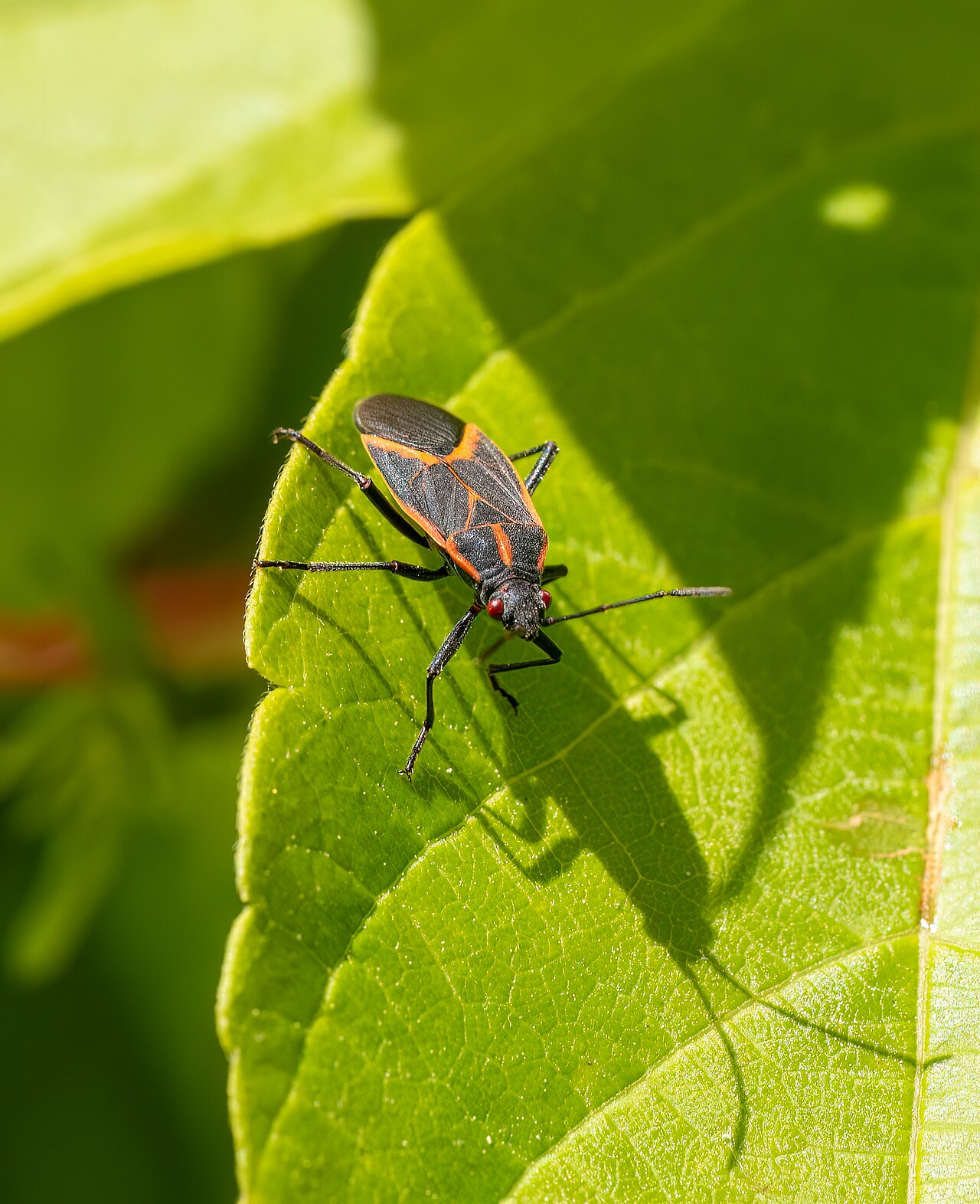
Every fall somebody texts us the same photo. A sunlit stucco or brick wall with a few hundred black-and-orange bugs crawling slowly across it, usually the south or west side of the house, usually a neighborhood with old boxelder trees along the ditch bank.
Boxelder bugs. They’re harmless in almost every way that matters, and they’ll still make you want to move. The part worth knowing right now, in early August, is that the window to actually do something about them is open. It shuts the week they start piling up on your wall.
What they are and what they want
An adult is about half an inch long, flat black, with three orange-red stripes across the shoulders and orange lines outlining the edges of the wings. The nymphs are much smaller and bright red, and those are the ones people send us in July asking if they’re baby ladybugs or something worse.
They feed on boxelder trees, specifically the seeds. Maple and ash will do in a pinch. Here’s the part that explains a lot: boxelder trees are either male or female, and only the females make the winged seed clusters. That’s why one house on a Spanish Fork street gets buried and the neighbor two doors down barely sees any.
And range is bigger than you’d think. They fly. A couple of blocks is nothing to them, so the tree feeding your problem may not be anywhere on your property. We’ve had homeowners cut down a perfectly good shade tree and still get the same wall full of bugs the next October.
Why they pick the south side
They’re not coming for your kitchen. They’re coming for winter.
Boxelder bugs survive the cold as adults, tucked into something protected, and starting in September they go looking for that spot. They navigate by warmth. As nights cool off, they gather on whatever surface holds the afternoon sun longest: south and west facing walls, light-colored brick and stucco, garage doors, window trim. They bask there through the warm hours, then start working into whatever gap they can find.
Behind the siding. Into the soffit. Under a lifted shingle course. Through the gap around a window frame or a hose bib. Into the attic through a torn vent screen. Then they go quiet for the winter.
That’s why a boxelder bug in your living room in January is worse news than a hundred on your wall in September. It means they’re already inside the structure. On a warm winter afternoon a few wake up, get confused about which way is out, and come out at the window instead of the wall. There’s no practical way to treat inside a wall void, which is why we push people to handle this before the bugs get there.
What they will and won’t do to you
Worth being straight about, because the panic usually outruns the actual threat.
- They don’t bite or sting. They have no interest in people or pets, and they’re not venomous.
- They don’t damage your house. They don’t chew wood, they don’t eat fabric, they don’t nest, and they aren’t going to hurt your boxelder tree either.
- They don’t breed indoors. The ones overwintering in your walls are just waiting out the cold. They’re not multiplying in there.
- They stain. This is the real complaint. Crush one on a curtain, a carpet, painted trim, or light-colored siding and you get a reddish-orange smear that does not come out easily. Their droppings do the same thing.
- They stink when squished. They’re related to stink bugs and they’ve got the same defensive scent gland.
So the rule for the ones that get inside is simple: vacuum, don’t squish. A shop vac handles a windowsill full of them in seconds. Outdoors, soapy water in a pump sprayer kills them on contact, but it leaves nothing behind, so you’ll be out there again tomorrow.
One more reason not to let them die in your walls: a wall void full of dead insects feeds carpet beetles, and those genuinely will chew wool, felt and stored clothing. The boxelder bug isn’t the pest that costs you money. What comes to eat it might be.
Timing is the entire game
An exterior barrier treatment works on boxelder bugs. It works well. But it has to go on before they aggregate, not after.
In Utah County that means late August through mid-September, while they’re still out on the trees and before the first cold nights push them onto the walls. Put a treatment on the sunny walls, the eaves, the window and door frames, and the foundation line at the right time, and the bugs that land there don’t stay long enough to find a gap.
Wait until they’re stacked three deep on the garage door in October and it’s a different conversation. We can knock down what’s on the wall, but a fresh wave lands the next warm afternoon, and every bug already behind the siding is out of reach.
What you can do yourself before then
The sealing work matters as much as the spray, and it’s the same list that keeps mice out later in the fall:
- Caulk the gaps around window and door frames, especially on the sunny side
- Fix or replace torn window screens and worn weatherstripping
- Screen attic, gable and soffit vents, and check the ones you screened years ago
- Seal around utility penetrations where the gas line, hose bibs and AC lines pass through the wall
- Rake up the seed piles under boxelder and maple trees instead of letting them sit all fall
None of that is glamorous, and all of it pays off twice.
How we handle it
We treat boxelder bugs as a specialty job rather than part of the standard year-round list, because the timing and target areas are specific to them. It’s an exterior application aimed at the walls and entry points they’re actually using, scheduled for the front end of the season, with a follow-up if the fall runs warm. Service starts at $199, and we confirm the price on site.
If you got covered up last year, from Payson to Springville, now is the month to get on the schedule instead of calling us in October when it’s already a cleanup. You can get a quote online or call us at (801) 494-3707 and we’ll come look at your sunny walls before the bugs do. Yes, we can.