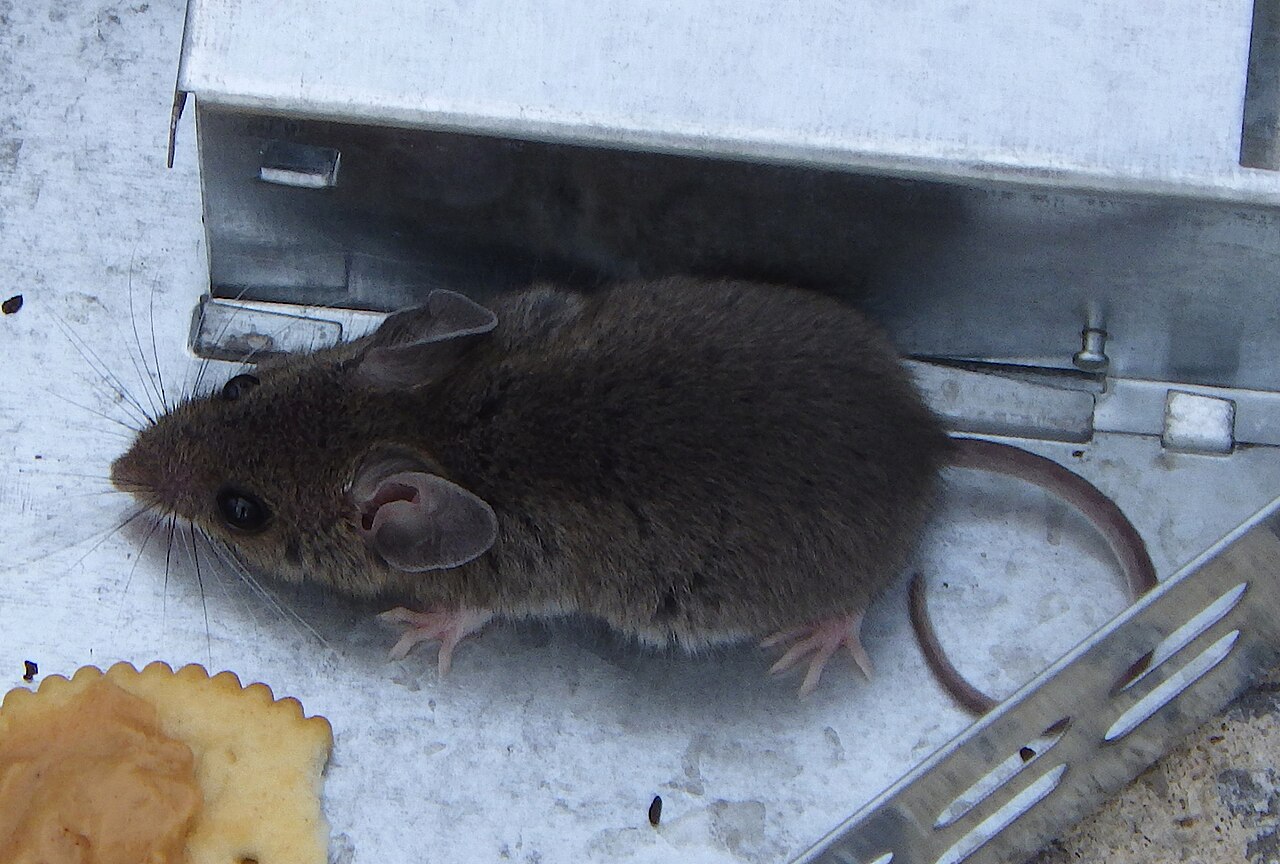
Late July is early to be talking about mice, and that’s exactly the point. The houses we seal up in August and September are the ones that stay quiet all winter. The ones that call us the week before Thanksgiving are already sharing the pantry.
Something we notice every fall: it’s almost never one house on a street. We’ll do a rodent job in Salem, and within a month we’re back on the same block for two more.
Mice don’t move in from far away
A house mouse lives its whole life in a range of roughly ten to thirty feet. It isn’t crossing town to find your kitchen. Whatever turns up in your garage in October was already living within a lot or two of your house: in the field behind the fence, under the neighbor’s shed, in a woodpile, along the ditch bank.
That’s why mouse problems cluster. When something changes on your street, the local population has to go somewhere, and “somewhere” gets measured in yards, not miles. The usual triggers:
- A field or orchard gets cut, or a lot gets scraped for a new build
- The neighbor finally seals their house (the mice are still around, they’re just newly homeless)
- Somebody cleans out a shed, a chicken coop, or a stacked woodpile
- Nights drop into the forties and every mouse in the neighborhood starts hunting for a warm wall
Utah County hands us all four in the same six weeks. Harvest, construction, and the first real cold snap tend to land together, and from Santaquin up through Springville the calls start almost on schedule.
The gap is smaller than you think
A mouse doesn’t need a hole. It needs about a quarter inch, roughly the width of a pencil, because its skull is narrow and everything behind it is soft. If you can slide a pencil in, a mouse can follow it.
The openings we find over and over:
- The bottom corners of the garage door. This is number one, and it isn’t close. The rubber seal runs straight but concrete never is, and the corners where the seal meets the track almost always leave a triangle of daylight.
- Utility penetrations. Where the gas line, the hose bib, the AC line set, or the dryer vent passes through the wall. Most of these were foamed once at construction and never touched again.
- The gap between the foundation and the bottom course of siding. Especially on homes with stucco or stone veneer.
- Crawl space and foundation vents with rusted or missing screen.
Grab a flashlight some evening and walk the outside of your house at ankle height. You’ll find more than you expect, and the garage will be the worst of it.
One mouse is never one mouse
The reason we push exclusion so hard is the math on how fast they breed. A female house mouse can produce a litter of about five or six young roughly every three weeks, and those young are breeding themselves at about six weeks old. A pair that slips into your rim joist in September is not a pair by February.
They’re also nocturnal, which is why the first thing most people notice is sound. Scratching in the wall right after the house goes quiet, usually the same spot every night, because mice have poor eyesight and navigate by touch. They hug edges and run the same routes along walls and joists instead of crossing open floor.
The other early sign is droppings, dark and about the size of a grain of rice, showing up in the back of a cupboard, along the garage wall, or in the utility closet by the water heater.
What it actually costs you
The chewing is the part homeowners underestimate. Rodent incisors grow continuously, so mice gnaw constantly to keep them worn down, and they don’t care what they’re gnawing. Wiring insulation in an attic or behind an appliance is a genuine fire risk, and it’s the kind of damage nobody finds until something stops working.
Then there’s contamination. Mice urinate as they travel, so the trails they run get soiled, and nesting in blown-in insulation turns an attic into a mess that has to be removed rather than cleaned.
There’s a health note worth taking seriously here. Utah has deer mice as well as house mice, and deer mice can carry hantavirus. Infection is rare, but it’s real in the western states, and it comes from breathing dust stirred up from droppings and nesting material. So if you find a contaminated area in a shed, a crawl space, or a cabin, don’t sweep it and don’t vacuum it. Ventilate the space, wet everything down with a disinfectant first, and wear gloves. If it’s a big area, let us handle it.
Traps alone don’t finish the job
Snap traps have their place. We use them. But a trap only deals with what’s already inside, and it does nothing about the reason your house got picked or the opening they used to get in. Catch six mice and feel like you won, and the seventh walks in through the same gap the following week.
The other thing to know: expanding foam by itself is not exclusion. Mice chew right through cured foam. It has to be backed with something they can’t get their teeth into, like copper mesh, steel wool packed tight, or hardware cloth, and then sealed.
How we handle it
A real rodent job has four parts. We inspect the whole structure and find how they’re getting in, we remove the active population, we do the exclusion work to seal those entry points properly, and then we monitor to confirm it stayed sealed. Skip the third step and you’ll be calling somebody again next fall.
Rodent service with us starts at $495, and that includes the exclusion work, not just the trapping. We confirm the price on site once we’ve walked the house, because a rambler in Payson with one bad garage corner and a two-story in Provo with a rodent-run attic are not the same job.
If you’re hearing something in the wall, or the neighbor just mentioned they’ve got mice, this is the month to get ahead of it. You can get a quote online or call us at (801) 494-3707 and we’ll come walk your foundation line before the weather turns. Yes, we can.