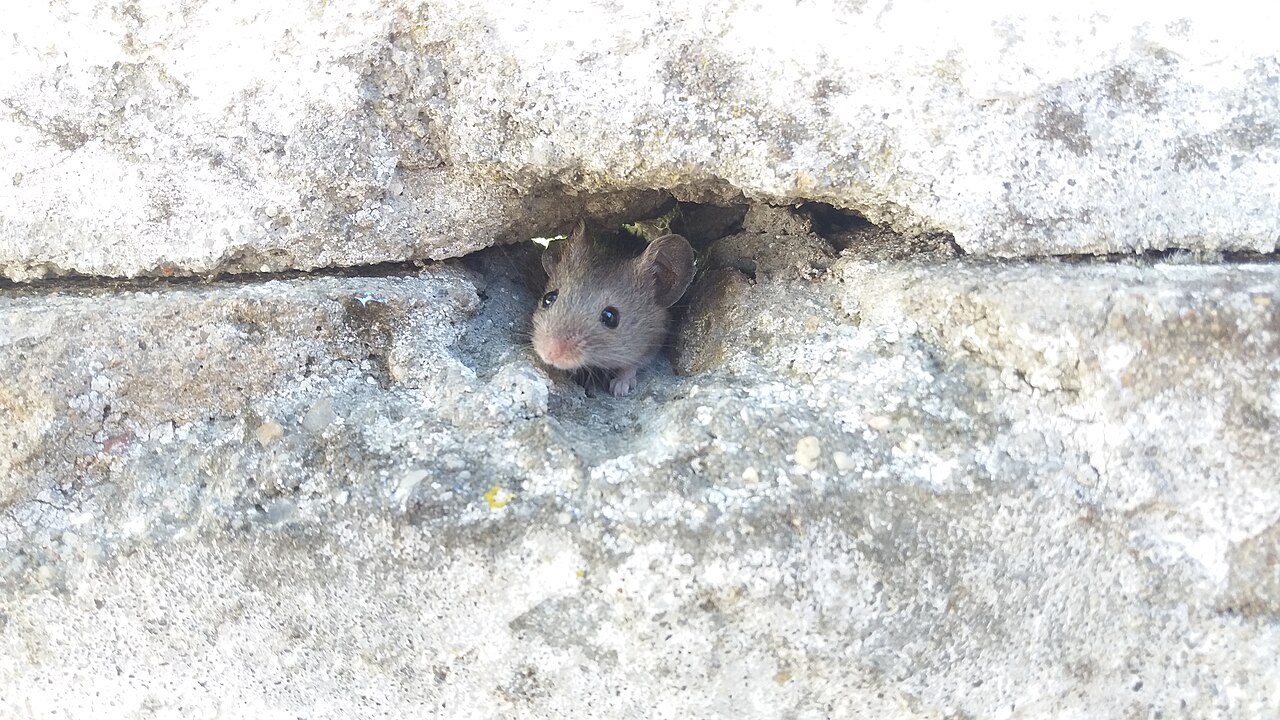
It starts around eleven at night. The TV’s off, the furnace has cycled down, and there’s a light scratching in the wall behind the headboard. It stops when you sit up. Then a minute later it’s ten feet down the wall, near the closet, and it sounds like somebody dragging a fingernail across the back of the drywall.
We hear about this all year, but the calls stack up starting in September. Nothing changed in your house. What changed is that the nights got cold, and something that was living in the yard in August is now living in the stud bay behind your bed.
Why the noise only happens after dark
House mice are nocturnal by default, with their heaviest activity in the couple of hours after sunset and again just before dawn. That’s not a preference so much as survival. Owls, cats, hawks, and people are all daytime problems for a mouse, so a mouse that runs at 2 p.m. tends not to become an old mouse.
The other half of the answer is your house. During the day there’s a furnace fan, a fridge compressor, kids, a TV, traffic outside. All of that buries the sound of a half-ounce animal moving inside a wall cavity. When the house goes quiet at night your noise floor drops and the mouse becomes audible, usually well after it moved in.
So scratching at night and silence during the day isn’t evidence of a small problem. It’s evidence of a normal one.
Reading what you’re hearing
We ask a handful of questions on the phone before we ever get to the house, because the sound tells us a lot.
- Light, fast, scratchy, and it moves quickly. Skittering that travels several feet in a second or two, often with a soft rustle behind it. That’s mice. A house mouse weighs about half an ounce, so you get sound without any real thump.
- Heavier. You can tell something has weight. Slower movement, a dragging noise, occasional gnawing that sounds like a small saw. That’s usually a rat, and in Utah County that most often means roof rats in an attic or a crawl space rather than in an upstairs wall.
- Loud, in the daytime, and coming from the attic. Rolling, thumping, sometimes something that sounds like a walnut being pushed across the ceiling. That’s a squirrel. Squirrels are diurnal, so daytime racket almost always rules mice out.
- Chirping, fluttering, or scratching right at first light. Birds, usually starlings in a vent or a soffit gap.
- Scratching and squeaking that picks up right at dusk. Possibly bats leaving a roost, which is a different job with its own rules and season.
Homeowners in Provo and Springville often tell us it sounds “way too big to be a mouse.” It usually isn’t. A wall cavity works like the body of a guitar. Drywall is a thin membrane over a hollow box, and a mouse tapping insulation against the back of it gets amplified into something that sounds like it should have a tail three feet long.
Where in the wall they actually are
Mice are edge runners. They have poor eyesight and navigate by whisker contact along surfaces, so they follow the same routes over and over instead of crossing open space. Inside your walls those routes are the framing: the top plate where the wall meets the ceiling, the bottom plate at the floor, the rim joist above the foundation, and the vertical chases where plumbing and wiring pass between floors.
That’s why the sound seems to travel a straight line, and it’s why it can seem to come from a room the mice have never been in. Sound conducts through framing lumber. When somebody says the noise is above the bedroom ceiling but we find the nest over the garage, that’s not a mystery. It’s a joist running from one to the other.
The part that costs money
The scratching is annoying. The gnawing is the actual problem.
Rodent incisors grow continuously through their entire life, so mice have to chew constantly just to keep their teeth worn down. They aren’t picky about what they wear them on, and inside a wall the options are wood, insulation, PEX water lines, and wiring. Chewed wiring insulation in a wall or attic is a real fire risk, and it’s the kind of damage that hides until an outlet quits working or something smells hot.
Nesting does the slower damage. Mice shred insulation and paper into nests and urinate along the runs they travel, which is what produces the musky ammonia smell people notice in a closet or at the top of the basement stairs. Blown-in attic insulation that’s been nested in has to come out. It doesn’t clean.
Why poison in the wall backfires
Somebody hears scratching, buys bait blocks, and tosses a handful into the attic or behind the fridge. A mouse that eats bait in your wall then dies in your wall, usually somewhere with no access panel. That’s one to three weeks of a smell you can’t locate and can’t wash out, plus blow flies and carpet beetles working on the carcass. We’ve cut open drywall in Payson and Mapleton to retrieve exactly that, and the repair is on the homeowner.
Bait has a place, in tamper-resistant stations placed outside where the pressure is coming from. Loose in the interior of a home is not that place, especially in a house with kids or a dog.
What actually ends it
A real rodent job is four things, in order. We inspect the structure and find the openings, we remove the active population with traps set on the runways instead of in the middle of the floor, we do the exclusion work to seal the entry points with materials mice can’t chew through, and then we come back to confirm it stayed sealed. Skip the sealing and you’re just harvesting mice out of a house that’s still open.
Our rodent service starts at $495 and includes the exclusion work, not just the trapping, with the final price confirmed after we’ve walked your house. Twenty-three years of doing this in Utah means we know the six or seven places to look first.
If you’ve been listening to something behind the drywall and hoping it goes away on its own, it won’t. Get ahead of it before the weather turns and the rest of the neighborhood’s mice come looking too. You can get a quote online or call us at (801) 494-3707, and we’ll come find out what’s in there and how it got in. Yes, we can.