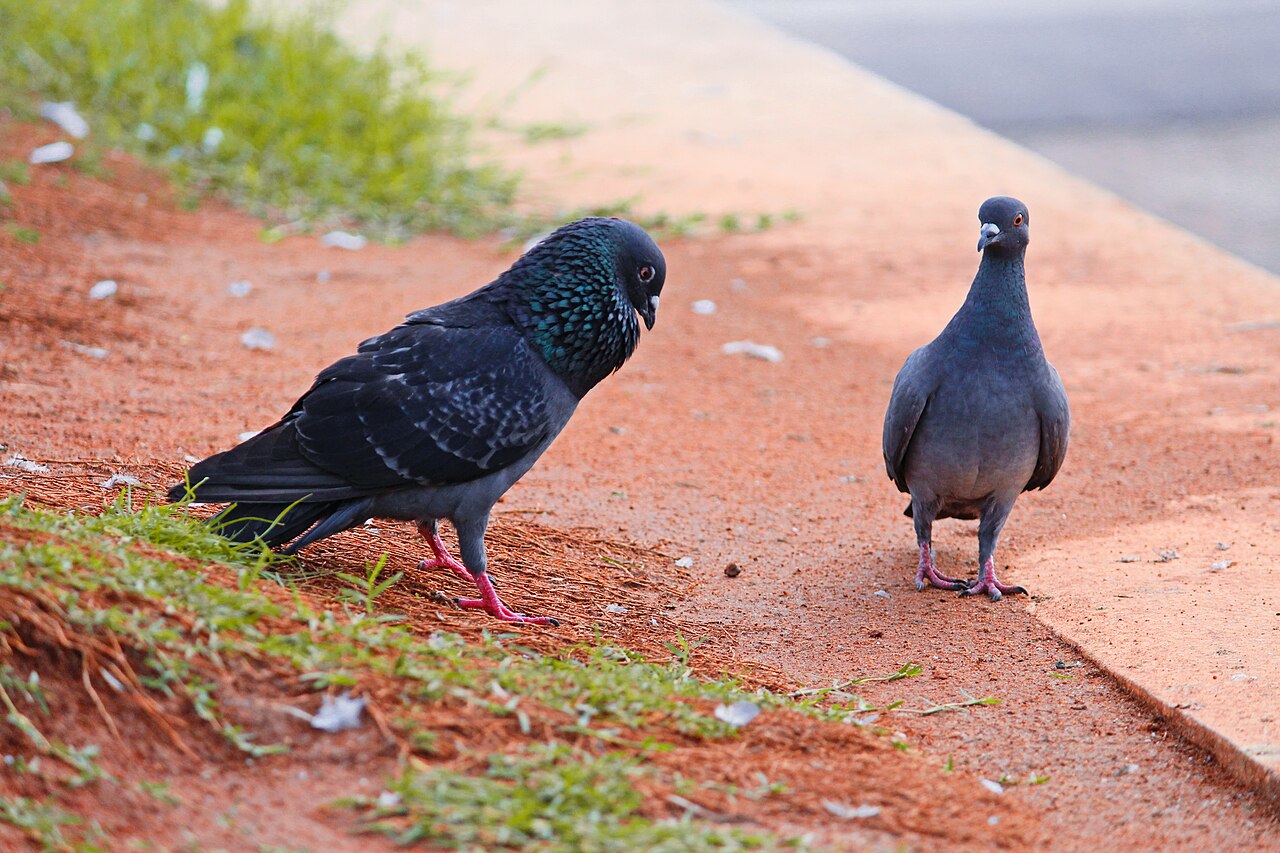
Two pigeons on the ridge of your roof is a postcard. Two pigeons that decide your roof is home is a bill, and the bill grows every month you let it ride. We get calls about pigeons all over Utah County, and almost every one starts the same way: “they showed up in the spring, and now there are fifteen of them.”
That’s how pigeons work. They don’t visit. They move in, they raise young on your house, and the young come back and raise their own. Here’s what that actually costs you, and what getting rid of them really involves.
Why they picked your roof
Feral pigeons are descended from cliff-nesting birds, so they’re looking for ledges: the flat spot behind a chimney, the top of a wall under an eave, the sheltered gap where two rooflines meet. A modern two-story with a complicated roof reads like a cliff face to them, and the warm south side of a roof in Provo or Orem beats a canyon wall any day.
They’re also loyal to a spot in a way most birds aren’t. A pigeon that hatched on your roof considers your roof home for life. Scare them off and they circle the block and land again. That’s why the plastic owl works for about a week and why chasing them with a hose is a hobby, not a solution.
The other thing to know is how fast they multiply. Pigeons don’t have one nesting season. In a mild year they’ll raise brood after brood from early spring into fall, a couple of eggs at a time, over and over. A pair in March is a flock by October.
The droppings are the expensive part
Pigeon droppings are heavy in uric acid, and that acid works on whatever it lands on. On asphalt shingles it breaks down the surface and shortens the life of the roof. On metal flashing, rain gutters, and AC units it corrodes. On paint and stucco it etches and stains. A ledge that pigeons have used for a season has a crusted white streak under it that doesn’t pressure-wash away clean, because the surface underneath is already eaten.
It adds up faster than people expect. Droppings from a resident flock can pile up inches deep in the spots they favor, and that pile holds moisture against your roof. We’ve seen rain gutters packed solid with droppings and nest material, sending runoff down the siding instead of the downspout. We’ve seen swamp cooler pads fouled so badly the whole unit had to be cleaned out before summer.
And the nests themselves cause trouble beyond the mess. Pigeons build with sticks, straw, and whatever’s around, and they build in vents and behind ledges where the material blocks airflow. A nest sitting in a dryer or bathroom vent is the same fire and moisture problem no matter what bird built it.
Solar panels are prime real estate
If you’ve put solar on your house, you’ve built pigeon housing. The gap between the panels and the shingles is shaded, warm, protected from hawks, and open at the edges. It is exactly the kind of covered ledge pigeons spend their lives looking for, and once one pair moves under there, the colony grows out of sight and out of reach.
The damage under panels is the kind you don’t see until it’s bad. Droppings accumulate on the roof surface where you can’t clean, nesting material packs around the wiring and mounting hardware, and the birds themselves foul the panel surfaces above, which cuts your power production. Getting a colony out from under an array, cleaning what they left, and screening the perimeter so they can’t return is real work, which is why we’d much rather screen your panels the month they’re installed than clean under them three years later.
The health side, honestly
We’re not going to tell you a pigeon on the fence is a health emergency. It isn’t. The concern is accumulation. Old, dry droppings in an enclosed or concentrated space can harbor fungal organisms linked to respiratory infections like histoplasmosis, and that risk is highest for whoever finally goes up to scrape the mess off, breathing the dust without protection.
Nests also carry bird mites, and when the young fledge and the nest empties, the mites go looking for a new host. If the nest was in a vent or under an eave by a window, that new host can be you. It’s the same call we get after starlings leave a bathroom vent, and it’s miserable.
So the cleanup matters as much as the removal, and it’s not a broom job. Wet it down, protect your lungs, or let us do it.
Why it’s a program, not a one-off
One thing worth knowing: feral pigeons aren’t a protected species in Utah, so unlike the wildlife jobs where timing and rules drive everything, the challenge here is purely practical. The birds are attached to your house, and every part of the fix has to account for that.
A real pigeon job usually stacks a few pieces. Deterrents like spikes on the ledges they loiter on. Mesh or netting to close off the sheltered spots where they actually nest, including the perimeter of solar arrays. Cleanup of the droppings and nest material so the flock’s own scent and mess stop advertising the site. And for an established flock, a deterrent feeding program that reduces the population over time instead of scattering it to your neighbor’s roof for a month.
Skip a piece and the birds find the gap. Spikes on the ridge do nothing about the colony under the panels. Cleanup without exclusion is an invitation to start over.
On pricing, so you’re not guessing: our pigeon deterrent feeding program starts at $1,595, bird spikes run $7 per foot of roofline, vent exclusion is $5 per foot, roof cleanup is $7 per foot, and solar panel mesh is $1.75 per foot around the array. Every roof is different, so we confirm the real number on site.
If your roofline has a resident flock, or your brand-new solar panels are already cooing, this is worth handling before another breeding season stacks the numbers. You can get a quote online or call us at (801) 494-3707 and we’ll come look at the roof, the panels, and everything the pigeons have claimed. Yes, we can.