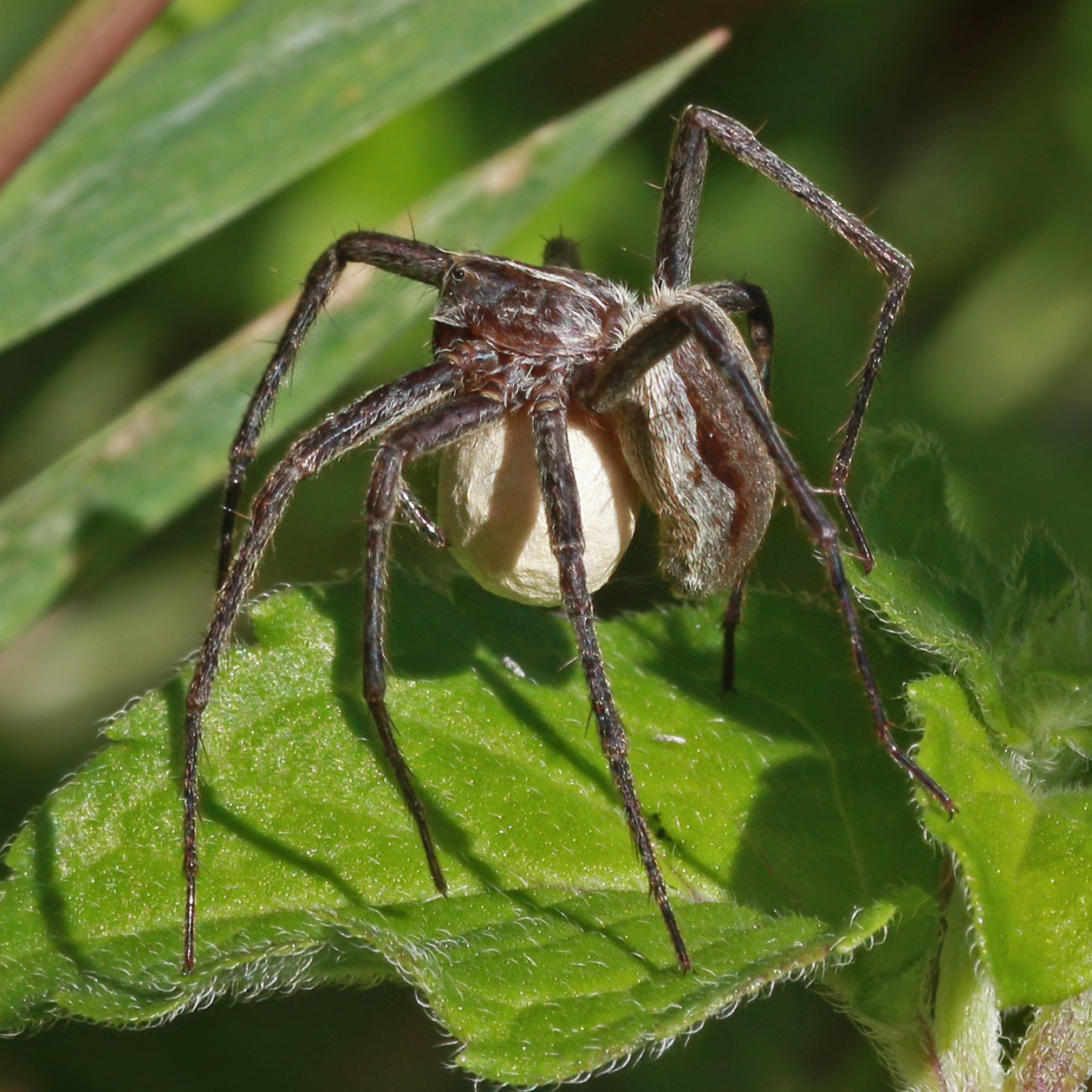
A black widow’s egg sac doesn’t look like much. It’s a papery little ball about the size of a pea, tan or cream colored, sitting up in the tangle of web in the corner of a window well. Most people in Utah County walk past a few of them every fall and never register what they’re looking at. Inside one of those is somewhere between a hundred and four hundred eggs.
That’s the reason we make a point of this every year. The spider you can see is one spider. The sac six inches above her is next year’s problem, and it’s a lot cheaper to deal with in September than it is to deal with in April.
Which sacs actually matter
Not every white blob in a web is worth your attention, so it helps to know what you’re looking at.
- Black widow. Smooth, papery, off-white to tan, roughly pea to marble sized, sometimes a little pointed on top. It hangs in a messy, strong web down low, and the female is usually right next to it. She’ll guard it. One female can produce several sacs over a season, and she doesn’t need to find a mate again to do it.
- Common house spider. Brownish, teardrop shaped, and you’ll often see three or four hanging in the same web in a garage corner. Harmless spider, but each sac still means a couple hundred more of them.
- Funnel weavers, including hobo spiders. Their sacs are flatter, more disc shaped, and hidden. Under a board, under a rock, back in the funnel itself, often coated with dirt and debris until it just looks like a lump of soil.
- Wolf spiders. Nothing to scrape off. She carries the sac attached to her spinnerets, and after they hatch she carries the spiderlings around on her back. You don’t find these, you find her.
The widow sacs are the ones we go looking for first. The rest are a numbers problem. That one’s a safety problem.
Where they are on your house right now
Almost every sac we pull is on the underside or the back of something that hasn’t moved since June. Get a flashlight, hold it low, and look up at the bottoms of things:
- Window wells. This is the number one spot in Utah and it isn’t close.
- Garage corners, along the top of the door track, behind stacked boxes, under the lip of a workbench.
- The underside of patio furniture, especially the seat pan of a plastic chair and the rim of a table.
- Deck rails, deck joists, and the gap where the deck meets the house.
- The wood pile, and the pallet the wood pile is sitting on.
- Meter boxes, sprinkler valve boxes, hose bibs, crawl space vents.
- Kids’ playsets, trampoline frames, and the trailer or boat parked along the side of the house.
We do a lot of homes in Payson and Santaquin where the whole population is living in four window wells and nowhere else. Clear those and the count drops off a cliff.
Why fall is the right time
In warm weather a widow sac hatches in about two to four weeks. Sacs laid late in the season sit through the cold, and spiderlings that already emerged tuck into the same protected pocket and wait out the winter there. Window wells, garages, and crawl spaces are exactly the kind of place that stays survivable in a Utah January.
Then the first warm stretch hits, they spread out, and the ones that make it start webbing up your eaves. Spiderlings disperse by climbing to a high point and letting out a strand of silk until the breeze carries them off, which is how a batch that hatched in one window well ends up all over the property.
So you can clear sacs now, while the weather’s good and the wells aren’t full of snow, or you can call somebody in May about a spider problem. The fall version is the same work at a fraction of the volume.
Why the spray can doesn’t handle it
This is the part that catches people off guard. An egg sac is dense, tightly woven, weather resistant silk. It’s built to sit outside through rain and cold and keep what’s inside alive. Residual product on the outside of that sac doesn’t reach the eggs.
Which means treating around a sac and leaving it hanging there accomplishes very little. It has to come off physically. That’s what de-webbing is, and it’s not the tidy-up part of a service visit. It’s the part that actually reduces the population.
Same goes if you’re doing it yourself: knocking a sac off into the lawn is not removal. It hatches in the lawn. Vacuum or brush it into something you can seal, and put it in the outside trash the same day. A shop vac works well as long as you empty it right away, because spiderlings will absolutely come back out of a canister sitting in the garage.
Wear gloves and long sleeves, use a long-handled brush or a wand extension, and don’t reach blind into the back corner of a window well. That corner is where the widow lives.
What we do about it
Our spider work is three things at once. We de-web the eaves, corners, window wells, meter boxes and vents, which takes the sacs off the house. We treat the harborage areas where widows actually sit, down low and out of the light. Then we knock down the insects they’re eating, because a house with a lot of spiders is usually a house with a lot of moths and midges coming to the porch lights first.
Spiders and black widows are both covered under our year-round plan, so for most homes this isn’t a separate call. That plan runs $199 for the initial service on a home up to 2,500 square feet, then $89 per quarterly visit after that. The fall visit is the one that pays for itself.
If you’ve got webs in the window wells and you’d rather not go poking around in them yourself, get a quote online or call us at (801) 494-3707. We’ll clear what’s there before it hatches into a spring problem. Yes, we can.