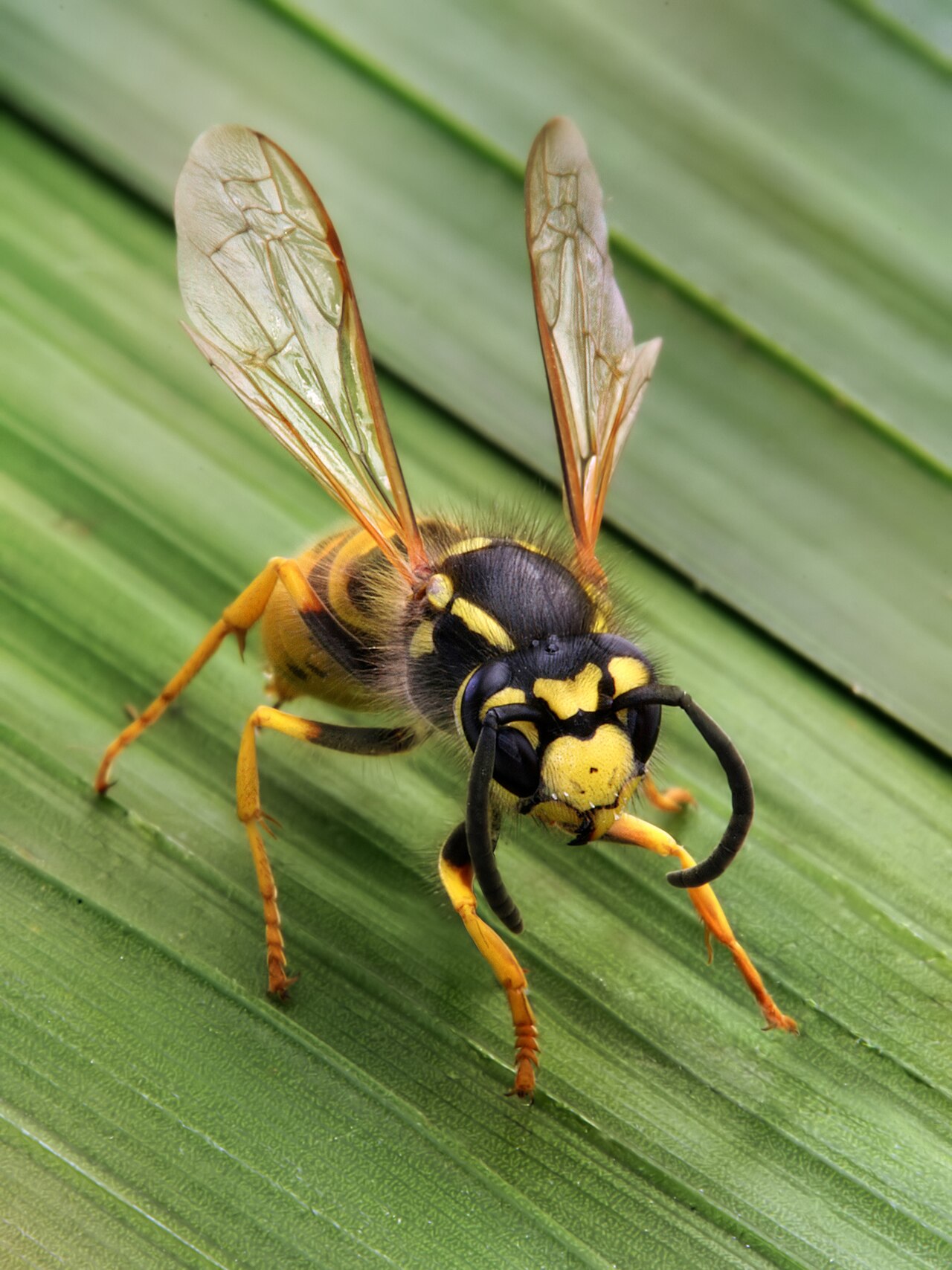
If it feels like the wasps around your house got meaner in the last few weeks, you’re not imagining it. Every July we start getting calls from Payson, Spanish Fork, and Provo that all say some version of the same thing: “They were never a problem before, and now I can’t eat dinner on my own patio.”
Here’s what’s actually going on, and what to do about it.
A nest you never noticed just hit full size
A yellow jacket colony starts every spring with a single queen and a nest about the size of a golf ball. Through May and June the colony stays small and busy, and most homeowners never notice it. By mid-July, that same nest can hold several hundred workers. By late August, a big one can pass a couple thousand.
So the nest that’s suddenly ruining your barbecue has probably been there since April. It just crossed the size where you can’t miss it anymore.
Their food supply changes, and so does their attitude
Early in the season, yellow jackets hunt other insects to feed protein to their larvae. That’s why they mostly left you alone in June. In late summer the colony stops producing larvae, and the workers switch to hunting sugar instead: your soda, your fruit trees, your kid’s popsicle, the garbage can by the garage.
At the same time, the colony is at maximum population and maximum defensiveness. More wasps, less natural food, and a nest full of new queens they’re wired to protect. That combination is why stings spike in August and September, not spring.
Where they nest in Utah County
Yellow jackets here don’t just build the gray paper nests you see under eaves. Some of the worst nests we deal with are ones you can’t see at all:
- In the ground. Old rodent burrows, gaps under landscaping rock, along fence lines. You find these ones with a lawnmower, which is about the worst way to find them.
- Inside wall voids. They slip in through a gap in the siding or a soffit and build inside the wall. You’ll hear a faint papery rustle or see a steady line of traffic in and out of one spot.
- Under decks, in sheds, in play sets. Anywhere sheltered with a small opening.
Paper wasps, which we also treat a lot of, prefer open comb nests under eaves and inside grill covers. They’re less aggressive than yellow jackets, but they’ll still defend the nest.
The two DIY mistakes we see every August
Spraying a nest at 2pm. The over-the-counter foam sprays can work on a small, visible paper wasp nest. But during the day, most of the colony is out foraging. You kill fifty and a few hundred come home to a wrecked nest and a bad mood. If you’re going to try it, dusk or dawn, and have a clear exit path. If the nest is bigger than a softball or you can’t see the whole thing, don’t.
Plugging the hole on a wall nest. This is the big one. If yellow jackets are going in and out of a gap in your siding, sealing that gap does not trap them inside to die. It traps them inside with one way left to go: through your drywall. We’ve been called to homes where a sealed-up colony chewed through and came out inside a bedroom. Treat first, seal later. Always in that order.
What we do differently
When we treat a stinging insect problem, we’re not just knocking down the nest you pointed at. We locate the nest (or nests, because where there’s one there are often more), treat it directly with products that reach the whole colony, remove it where possible, and then treat the spots on your house where they like to rebuild: eaves, soffits, deck framing, fence lines.
Wasp and hornet service with One Shot starts at $199, and like everything we do, it’s backed by our guarantee. If they rebuild between visits, we come back.
When to call
Call sooner rather than later if any of these apply:
- Anyone in the house is allergic to stings
- The traffic is going into a hole in the ground or a gap in the house itself
- The nest is bigger than a softball, or up high
- You’ve already sprayed it once and they’re still active
Every week you wait between now and September, the colony gets bigger and more defensive. A nest that’s a quick job in July is a genuinely nasty one by Labor Day.
You can get an instant quote online in about thirty seconds, or call us at (801) 494-3707. We’re local, we’re in Payson, and we’ve been doing this for 23 years. Yes, we can.